Friday, August 6, 2010

Chinese Women, Confucian Yin-Yang Theory, and Living out Virtue through the Female Body

One nice thing about writing this blog while I am researching and writing my MA thesis is that things from the blog help me understand my writing, and theory for my thesis helps me understand my life as a Chinese daughter-in-law. Last post I mentioned that many of my female Chinese friends as well as female relatives in the Liu and Chu families were expected to do with less physically than the men and children. They got the worst food, they typically did not get medical care until after their children were grown, and they were expected to work from before dawn to after dark doing all the housework AND earning money to help the family.

I recently finished a chapter in my thesis that was a survey of the different Chinese concepts of what constitutes an ideal woman. After writing my last post, I did one more check of previous scholarship to be sure that I had not missed any key points. Well, lo and behold, that insight into my family life helped me catch a major theoretical point that is perhaps not readily realized by Westerners. I found it very interesting, so I thought I would share it here.

Some people may be surprised to see that there is a Confucian Yin-Yang theory as most people see yin and yang as being part of Daoism. It is true; the earliest discussions of yin and yang were in the texts and shamanistic religious traditions that eventually morphed into Daoism. In that tradition, yin and yang are complementary forces that always rotate in a cycle to keep the natural world alive and moving. Yang is bright, strong, outward, and moving. The character literally means the sunny side of a hill. Yin is dark, weak, inward, and still. The character for yin means the shady side of a hill. Yang is fiery and related to qi or spirit; yin is damp and related to blood or physical matter. All things are seen as having a yang aspect and a yin aspect. In relational pairs, one thing will be yang in the relationship while the other will be yin. But the person or thing that is yin in one relationship can also be yang in a different relationship. Thus, in Daoism and in Chinese medicine, women are powerful. They are connected to the earth and water; they represent fertility and life blood. The earliest Daoist goddesses actually hold the power of life and death. They are related to the early matriarchal social structure that I mentioned in earlier posts on this blog and that is described in Julia Kristeva’s book About Chinese Women.

The yin-yang cycle was not strictly Daoist at the outset. It was more the framework for the earliest Chinese science and philosophy. This is how it is used, even today, in Chinese medicine. Therefore, it was not until the first century BCE, in the middle of the Han Dynasty, that yin-yang theory was worked into both Daoism and Confucianism. By this time, Confucius was long dead. His philosophy was one of relational ethics. He did not say much about cosmology; he was interested in what rituals and forms of conduct would make all people in society civilized so that life would be good for the greatest number of people. He lived in a time of civil unrest and war at the end of the Zhou Dynasty (1027-221 BCE). He was mainly concerned with how to cause society to be at peace so that everyone could prosper. His teachings are principally about how to use the rituals and etiquette from the earliest Zhou dynasty court rule books to maintain order in society. He also advocated education as a means of promoting social order and prosperity.

Confucius described three foundational relationships for society: ruler—subject, father—son, and husband—wife. His teachings were based on the ancient classics such as the Book of Odes and the Book of Rites. Some of the rituals in the Book of Rites probably came from the Shang dynasty (1700-1027 BCE, think oracle bones) to the Zhou, and they represent part of China’s most ancient customs. In the early days, China developed an idea that inside China people were civilized because they were agrarian and worshipped their ancestors at family tombs near which they lived. The nomads roaming on the plains outside China were barbarians. The rituals related to ancestor worship were crucial to the practice of Chinese civilization. Chinese have always been pragmatic; their concept is more about doing than about being, and this is where they differ most from the West. Their ethics are worked out practically through the rituals related to their relationships.

In early Chinese antiquity, the ancients developed a gendered division of labor. Men worked in agriculture, and women worked in sericulture. Both occupations were considered crucial to the survival of society, and men and women participated equally in the worship of the ancestors with the products of their labor. During the transition time from a matriarchal society to a patriarchal society, there was a time when China had a dual-lineage society for ancestor worship. But by the time of Confucius, family blood-lines for ancestor worship were patriarchal. Women still engaged in sericulture, but their labor was done for the husband’s family. Thus, Confucius and his students, like Mencius, taught that for women the practice of civilization was a matter of obedience. Women had three major roles in their lives. First, they were daughters who needed to obey their fathers. Then they were wives, who needed to submit to their husbands. Finally, they were mothers, who needed to follow their grown sons. Fathers, husbands, and sons had responsibilities to care for and nurture their daughters, wives, and mothers. At the time of Confucius, women were still considered more complementary than inferior to men in the practice of Chinese civilization that was supposed to benefit the entire world when carried out properly.

In the first century BCE, Neo-Confucian scholars married yin-yang theory to this Confucian idea of obedience. The primary scholar to change Confucianism was called Dong Zhongshu. Dong Zhongshu moved women from their complementary position to an inferior position. He said that although yin and yang were complementary, because yin was dark and passive and weak, it was always inferior to yang. He even went so far as to say that the yin component of any relationship could not have any accomplishment in and of itself. Thus, if a woman had a success, it was solely because of and for the sake of her father or her husband or her son. Prior to Dong Zhongshu, women were not associated with yin, but afterwards, they were seen as belonging to the earth, belonging to the lower physical realm, belonging to dirty blood, belonging to the darkness, and being far inferior to men.

Over the centuries, each wave of Neo-Confucianism seems to have pushed women further and further down beneath men. During the Tang Dynasty (618-907 CE), China implemented a civil service examination system, and the ideal for men changed. Prior to the Tang, an ideal man was adept at warfare and strong enough to till the fields. After the civil service exam became the way for any male in China to obtain an official post, the ideal man was literate and a good writer. Men proved their worth intellectually and spiritually by writing prose and poetry, composing and playing music, painting, excelling at chess, and showing prowess in other mental feats. Such talents fit in with the spiritual side of yang. By the Song Dynasty (960-1279 CE) women began binding their feet as a way of proving their feminine yin virtue. Since men were excelling spiritually, women had to excel physically, not by being strong (because yin is weak), but by showing their ability and self-discipline in enduring pain. The earliest forms of foot-binding did not break the bones as thoroughly as later forms in the Ming and Qing dynasties, but they were still painful. But these two lines of gendered excellence continued to develop until the late imperial era in the 16th through 19th centuries. In this period, men were expected to express literary talent as a manifestation of their yang spirit. Women were expected to express their virtue as a manifestation of yin by enduring physical hardship through foot-binding, child-bearing, service to family, suicide in the face of rape, and not remarrying as widows. Although foot-binding has been abolished, the other expectations live on among many Chinese families.

Girls are taught from a very young age that they must endure physical deprivations. Women play one-upmanship with stories of how much pain they have borne or how many physical hardships they have suffered. Anthropologists interviewing some of the few remaining women with bound feet learned that these women took pride that their ability to endure pain was proven by their “tiny lotuses.” Many Chinese women today have a similar mindset concerning the trials they bear for the sake of their families. The ability to endure all pain and bravely soldier on is the highest form of virtue for these women. Ideas and expressions of the spirit belong to the realm of men; physical pain and material tribulations are the milieu of virtuous Chinese women.

Saturday, July 31, 2010

Road Trip to the Olympic Peninsula

As I mentioned in the last post, the monetary gifts we got from Chinese friends at church gave us enough money to take Ma and Pa on a short road trip to the Olympic Peninsula before they left to return to Taiwan. Yuni was not really better, but he wanted to show his parents something in America that they hadn’t seen before. So we all piled into our huge station wagon. We had to put up the seats in the back cargo area, but there was still a little room for our overnight bags. Pa and one of the twins sat in the rear seats. Ma sat in the regular back seat with the other twin and Peace. Yuni and I were in front.


Yuni drove at the beginning. We went down to the Seattle waterfront and caught a ferry to Port Angeles. From there we went into the Olympic Mountains and took a short hike along an alpine meadow. The kids fed their snacks to the chipmunks. We could not go far because of my bad knee, Yuni’s health, and the kids’ young age, but we did have a lot of fun. When we came down from the mountains, we went to a wild animal park. It was similar to the one in Taiwan. You drove your car through, and the animals were just roaming. But all these animals were North American animals. There were bison, elk, and deer. The cougars and pumas were in cages that you walked past like a regular zoo. When you drove into the compound with the deer and bison, you were given a loaf of whole wheat bread to feed the animals. Pa and Love were in the back, and they kept throwing bits of bread out as we drove, until we were surrounded by a whole herd of bison, elk, and deer. One bison even stuck his head in the front window looking for more food. I quickly tried to put the window up, and I almost caught his black tongue as he was trying to lick the loaf of bread out of my lap. It was quite exciting. We were glad to have such a large, sturdy car.

We stayed in a motel along the Pacific Ocean. It was one of those old hotels from the forties or fifties. Each unit was a little cabin overlooking the beach. After unloading the car, we went and played on the beach for awhile. The next day we drove into the rain forest and took another short hike. Yuni had been doing all the driving, and of course, he had been walking along like nothing was wrong. After a day and a half of steady activity, pain hit. He could no longer drive, and we had to get back because Pa and Ma were leaving the next afternoon. Yuni slumped in the passenger side of the front seat, and I drove home down around the end of Puget Sound so that we could just keep moving. It was a two or three hour drive, and we made it home fine. But by the time we got everything upstairs from the car, my right knee (the one with bone scraping bone) was three times its usual size. I couldn’t put any weight on it. I had to sit on the living room couch with an ice bag, while Ma tried to figure out how to cook with an electric frying pan instead of a wok. I couldn’t walk for another two days. I missed seeing Pa and Ma off at the airport. Yuni took them, since it was late at night, and I stayed home with the girls. My knees were considered pre-existing conditions when we got our insurance, and so they would not be covered for another 21 months. We did not have enough money for me to see a doctor, so I just sat with my leg elevated, alternating hot and cold packs.

Later, a friend from church, who was mainland Chinese and doing post-doctoral studies at the University of Washington’s medical school, found me another mainland Chinese friend who was an orthopedist. I bartered editing services on the orthopedist’s research paper in return for a knee examination, but we couldn’t afford an x-ray. The doctor said that my bones must have scraped each other as I was pressing the accelerator and the brake, and after several hours, the nerves inside the bones had become inflamed. He offered me pain killers that he had brought from China. I did not take him up on that, but I did take a supply of sulfa antibiotics that I could use to self-medicate when my post-Peace infections flared up. I kept myself supplied with antibiotics from mainland China for several years as word went around among the mainland Chinese students that I would edit their papers for a combination of cash and barter, depending on our needs and their resources. It seemed like a good idea at the time because we didn’t need to worry about having Yuni miss work to get me to the doctor. We didn’t have to scrape together cash for the deductible, either. Later, I had a physical with a blood test, and the doctor told me that my liver function was low for a woman of my age. We went through the list of things I might have done to damage my liver, and I learned to my chagrin that there is a limit to how much sulfa you can take in your life time. Fortunately, my Chinese connections were able to recommend a good herbalist, who was also open to barter, so I began taking herbs for those complaints.

This is a very common pattern among working-class Chinese families. The husband and children go to the doctor whenever they get sick, but the mother is expected to make do with home remedies, especially when the children are small. Mothers are also expected to eat mainly leftovers and even partially spoiled food. Yet, the women work hard from dawn to well past dark doing both work for income and all the housework. My sisters-in-law and several of my friends all ruined their health this way. It didn’t work out too well for me, either.

Wednesday, July 21, 2010

Breadwinner Down

Yuni had what we thought was a problem with kidney stones. He had had it in Taiwan; some mornings he would wake up with excruciating pain in his kidneys. He would roll around in agony, but then he would get up and walk downstairs, go to work, and by evening when he went to a clinic, the pain would be gone. He had scores of x-rays taken, but the doctors found nothing. They told him that he had probably formed and passed a kidney stone.

He had a few attacks after we arrived in the US, but they occurred on work days, and he didn’t feel that we could afford it if he missed the opportunity to make money. Fortunately, he was working in a union shop, and after three months, we had very good health insurance. It included free check-ups and immunizations for the girls, and we only had a $500 deductible. On Memorial Day weekend, Yuni had another attack. It was a Sunday morning, so he did not need to go to work. He just lay in bed screaming. Finally, I called some church friends to see if they would take the kids to Sunday school while I took Yuni to the emergency room. The hospital closest to our home was a teaching hospital called Harborview. As we lived in the poorer section of town, it was full to the bursting with sick babies on a Sunday morning. After Yuni got up and walked a little, his pain subsided. We waited and waited with him lying on a bed, and finally we were seen by a student doctor. At first, he was going to discharge us quickly because the x-ray again showed nothing, but while he was waiting for the supervising instructor to come sign the discharge form, Yuni went into an attack again. The instructor berated the student for wanting to charge a patient in so much pain and ordered Yuni to take an ultrasound.

The line for the ultrasound was not very long, and within a short time, the entire class of ultrasound technologists were crowded around the screen showing Yuni’s kidneys. They could not tell me what they were looking at, but they did say it might be serious. I was freaking out. Back in the emergency room, the supervising teacher saw the film and told me that Yuni’s left kidney was blown up like a balloon. He asked a number of pointed questions as to how long the pains had been occurring. After finding out that this was a ten-year ailment, he said that the left kidney might not have any function left at all. He actually called in the head of the urology department to consult as to whether or not Yuni needed to be hospitalized immediately. The answer was no, but we needed to see the urology team on Tuesday and have some more tests done all that next week.

I was able to find friends to take the girls, but it was a very nerve-wracking time. Tuesday came around, and the urologist with his band of students told us that Yuni would definitely need surgery. He might even need his kidney replaced. We went home to look at the bank account because we did not know what we were going to do. Yuni was not working, so there was no income. I needed to accompany him to the hospital to translate because Mandarin translators were not as common then as they are now. We had fulfilled our deductible, but we still had to reach a threshold of $3000 before we had 100% coverage, and we did not have enough savings to live on AND to pay the medical bills. Yuni called his parents and told them what was going on. They arrived the next week with some money and to take care of the kids.

We did get some good news. The kidney still had 90% of its function, so the urologists said things were hopeful. They thought Yuni had a congenitally small tube that made it difficult for the kidney to drain. They were planning to go in and put in a stint. So plans were made; we called Yuni’s work. They would keep his job, but since he had only been there for 8 months, he did not have enough sick days or paid vacation to cover all the time off he would need to take. Pa and Ma brought a lot of money for them, but they had no idea of the relative costs of living. It was enough to support the family including them for the month Yuni would be off work, but it was not going to be enough to cover the medical bills. Yuni did not want to ask my family because he thought it would be a huge loss of face for him and Pa. I was saying lots of fervent prayers.

The surgery took much longer than the surgeons had expected. Ma and Pa and the kids and I were all sitting in the waiting room outside the operating rooms. Finally, the head of the urology department came out to tell us what had happened. When they got Yuni opened up, they discovered that the problem was not a narrow ureter; instead, Yuni had an extra branch off his aorta that pushed the opening in the kidney shut when he lay in certain positions. When he got up and moved around, things would shift a little, and the kidney would drain. This was why he had so much kidney function left, and it was also why the doctors had never found any traces of crystal when they thought he had kidney stones. If the surgeons had even nicked the branches of the aorta going into his kidney, he could have bled out, so they had taken the time to proceed slowly and carefully. That condition is congenital, and it only occurs in one out of every one hundred thousand patients. Of course, the surgery was too exciting to miss, and all surgical students had been called in to observe the condition that most doctors only get to read about. The surgeon himself had never performed the procedure, so he had taken extra care to do it right in front of all the surgical students. This was a good thing for the medical school, the students, and Yuni, but they forgot to tell us it was going to take an extra hour or so. Ma and I were almost crazy with worry.

To fix the problem, the doctors had to carefully detach the tube from the kidney and reattach it at a lower point away from both branches of his aorta. Then they had to be sure that everything was stitched up tightly so that nothing would leak in his body. They also had to cut around to approach it from behind, so he wound up with a huge 9 inch scar across his mid-section. He remained in the hospital for a whole week while the doctors made sure that everything was healing properly.

Every day that week, I would make breakfast and then leave the kids with Ma and Pa. I drove the car to the hospital and rushed in to get there before the morning rounds. Yuni did not speak enough English to answer the doctors’ questions. Every day, he had the largest contingent of doctors looking at him. He was quite the celebrity. The hospital was a mile and a half from our house, so Ma and Pa would walk the kids down for visiting hours at 4 pm. They would stay and watch Yuni eat his dinner at 5, and then I would drive everyone home about 6:30 or 7 when visiting hours were over. When we got home, I made dinner and went to bed pretty early. That week went by very swiftly.

Yuni was not allowed to work for three weeks. He stayed home resting and chatting with Ma and Pa for about ten days before he was totally bored out of his skull. We did have lots of visitors from church, and even though I had not spoken with them about our need, their generosity was an answer to all my prayers. We were short $2000 for the medical bills plus the expenses we would have for the two weeks after Yuni went back to work and before he got his first check. People from church kept giving us gift cards with cash inside. One person gave us an envelope with $2000, just enough to pay off all the outstanding medical bills. The rest of the money added up to enough for our living and enough to take Pa and Ma on a weekend trip to the Olympic Peninsula and rain forest.

As I watch the news these days, I sometimes wonder what some of our lawmakers are thinking when they accuse the unemployed of laziness or when people get so upset about unions. I am so thankful Yuni had the union job with the union health insurance. We still didn’t have enough money by ourselves, but it was much easier to come up with just a few thousand dollars for medical expenses and groceries and rent than it would have been to have come up with the $100,000 that the surgery alone had cost, much less the tests. We were not extravagant; we were working class poor. We still needed help from the food bank most weeks, and with that help we were able to save a few hundred dollars here and there, but we had not had time to build up much savings. I was very disappointed this year when the health care bill was passed without a public option for low-income people. We were so lucky to have had that health insurance because later in the calendar year of Yuni’s surgery, Truth stepped on a wasp and her foot swelled up to the size of a football. Then Peace got an intestinal flu and needed to go to the emergency room three times for IVs to prevent dehydration. Because we had good health insurance, our family was able to get through those small emergencies without any problem. The union used economies of scale to negotiate directly with the insurance company to get good coverage that was great for its members and cheaper for the employers. A public option could do the same thing on a national level.

Thursday, July 8, 2010

Favorite Field Trip #1: Woodland Park Zoo


The girls were loaded down with loot that holiday season. They got cute designer dresses and toys and books and everything children could want and then some. My dad even bought them a tree-house slide for the playroom so they wouldn’t get bored on rainy days. That winter my family, Yuni and I began a running argument about the American tradition of giving presents. Chinese give gifts of money or solid gold jewelry to close relatives; the only non-valuable items they give are food items to more distant relatives and friends. My family wanted Christmas wish lists from all of us, and Yuni just asked for money. My family members wanted to give us something more “personal.” I kept trying to explain the cultural differences, but I was the daughter on one side and the wife on the other, so I was expected to whole-heartedly agree with both sides and convert the others. In the end, my family compromised by buying jigsaw puzzles or work shirts for Yuni to unwrap and then giving him gift certificates to hardware stores so he could purchase tools for his weekend jobs. After many years, my family understood the Chinese culture better and started giving us checks. By then, Yuni kind of liked opening presents and became nostalgic for having something to open. But that first year, he came home fuming that we had not gotten cash or anything to eat. I guess he felt that my family did not think him a close family member. I got sweatshirts and family passes to the zoo, the science center, the aquarium, and the children’s museum. The girls and I were all ready for spring.


Our apartment was right on the bus line. We went downstairs and walked a few yards to the bus stop. One adult fare took us all over. Ma Liu had made me an extra-long cloth carrier for the girls. When they were little, I took more wraps at the bottom; as they grew, they had less cloth holding them to me. The carrier was just a strip of checkered cloth that was several yards long. I looped it under the girl’s arms, swung her up on my back, crossed the ends in front with one short and one long, then I wrapped the long end around and around my waist under the girl’s rear making a sling for her to sit in. I tied off the ends in a knot, and she was secure. My grandma had given me a backpack for Christmas to take on our excursions. The carrier was always in the bottom of my pack, and whenever a girl got too tired to walk, I would put her on my back for a short nap. I couldn’t carry any one of them for too long because of my bad knee, but we managed.


One of our favorite places was the Woodland Park Zoo. It has natural-like habitats for its animals, and we would stand for hours in front of the cages watching the animals engaged in normal behaviors. The keepers there did their best to give the animals their food in ways that required them to forage like they would in the wild. The elephants had to walk through their pen to find bales of hay in the outside yard. The gorillas had to pick food off tree branches. On Thursdays, the keepers poured live fish in for the penguins, and they had to catch them. One of the perks of having membership cards was access to members-only classes. We got to go behind the scenes at the reptile house and the feline house. We learned about the elephants and different eco-zones. We also learned about raptors and alligators and many other exotic species.


The bus ride itself was an adventure. We would take the bus down into the International District and then transfer at Pioneer Square. Sometimes on the way back, if we had just missed the bus up the hill, we would walk around old town Seattle and visit the Klondike Gold Rush National Park Museum. (I think it’s the country’s smallest national park.) There is a trough in the museum where you can pan for gold and then put it back when you are done. The girls loved to play with it.


Many of Seattle’s homeless would congregate at the gazebo in Pioneer Square right near our bus stop. There I was with my three little racially mixed children, all of whom were under the age of three. A couple of times the panhandlers gave each of the kids money and said: “Listen to your mama. Stay in school. Don’t wind up on the streets like us.” They were all very nice to us. It was an interesting experience.


In general, our life was really fun. We didn’t have much money, but with the annual passes, we could go to interesting places several times a week for the cost of one adult bus fare. On the Saturdays that Yuni did not have work, he would drive us to one of our haunts, and the whole family would play.

Sunday, June 27, 2010

The Joy of Great-Grandkids


One of the best things for us in America was the fact that all four of my grandparents plus my dad, brother, aunt, and uncle were all living in the Seattle area, and we had the only little kids. Every weekend we would go to my maternal grandparents’ condo near the University of Washington. My grandfather had cancer, and they had in-home care. The helpers were co-opted into cooking and preparing for our visits. My grandmother’s cleaning lady/household assistant would take her shopping every week, and she always bought the stores out of the kids’ favorite foods: grapes and chocolate-covered marshmallow cookies. We usually had a large, hot lunch with my grandparents either Saturday at noon or Sunday after church.


My grandmother also bought the stores out of educational toys for the kids to play with at her house. We were not allowed to duplicate those toys at our house; they were only for trips to the condo. She bought a Thomas the Tank Engine train, building blocks in a wooden cart, and numerous other things. And she always had a stash of children’s books that she and my grandpa could read to the kids.

My grandparents were not really interested in talking to Yuni and me. They just wanted to watch the kids busily playing on the carpet in front of them. Yuni would frequently nap on the couch until it was time for our meal. When he was rested enough, he would get down on the floor and play with the kids’ toys, too, because, as he said, when he was growing up, his family had been too poor to have toys for the kids.

Every other Sunday we crossed the floating bridge from Seattle to Bellevue. We went to church near my dad’s condo and then visited him and his parents. We would eat at dad’s condo or have a picnic in a nearby park, and then we would go to the nursing home/apartment complex where Dad’s parents lived. Dad’s mother was in the apartment part, and her place was stuffed with toys for the kids, too. She bought the stores out of stuffed animals and dolls. She also specialized in Disney videos for the kids. They would watch Beauty and the Beast or Little Mermaid or Cinderella. The kids would sing and dance to their favorite songs. During visiting hours, we would go downstairs to the nursing home to see my dad’s father, who had suffered a stroke and was in a wheelchair. There were no toys on that floor, but the kids would sit on Gramps’s lap or turn somersaults on the floor. Their visits were a real highlight for him.

Birthdays and holidays were celebrated several times over with the two sets of grandparents and great-grandparents and aunts and uncles. The kids got loads of nice clothes and toys and gifts. They loved visiting the grandparents, and the grandparents loved interacting with them.

We had a number of adventures while visiting the old folks. The Sunday after the snowstorm, we were crossing the I-90 floating bridge on our regular visit to Bellevue. All of a sudden we noticed that the old floating bridge, which was undergoing repairs in its pontoons, was acting strangely. There had been lots of rain that had finally melted the snow, but for some reason the hatch covers of the pontoons under repair had been left open over the weekend. The chambers had filled with water, and the bridge was starting to sink. We watched as section after section began to settle to the bottom taking graders and tractors and cranes with it. The kids, of course, got very excited watching this from their car seats. Yuni was afraid that the currents of the sinking bridge would affect the new bridge that we were driving on. He hit the gas, and we sped out of there many miles over the speed limit. We got safely to the other side. At noon that day, we watched the whole thing again on the news while we were eating lunch at Dad’s place.

The floating bridge in 1940
Photo by Jet Lowe
HAER: Lacey V. Murrow Memorial Floating Bridge, Spanning Lake Washington at I-90, Seattle, King County, WA


The day after our trip to see the grandparents
Phil H. Webber/Seattle Post-Intelligencer


Then we got to watch repairs from our kitchen window

 
Another time, we were trying to get into my mother’s parents’ condo when all of Seattle seemed to be going to a Huskies football game. We were trying to turn left across two lanes of traffic without a light. The car in one lane waved us over, and there seemed to be no cars in the far right lane. We zipped across, but just as we were getting into the driveway, we got hit by a car speeding down the right lane, and our muffler got knocked off. No one was hurt, but we made an incident report to the police. In the end, it was our fault because we had been turning left. Yuni insisted that we go to traffic court and argue about it because he was sure that the other car was driving outside the lane on the shoulder. Unfortunately, we couldn’t prove anything and because we had been going uphill, the policeman found our muffler just inside the edge of the lane of traffic. It was a lesson for Yuni about how the US court system works. And I got my first taste of interpreting in court. We also learned the value of car seats for children.

Taking the kids to spend time with the great-grandparents was a big part of our lives for many, many years. Even after the great-grandfathers passed away, we continued making regular visits to the great-grandmothers. It seems like such a small thing, but I think it was very important. And I think it is an experience that many Americans miss because our culture does not like old. When I was growing up, I knew five of my eight great-grandparents. One of my great-grandmothers was the first white child born in O’Neill County, Nebraska. She had been conceived in Ireland and born here in the USA. One of her younger sisters was kidnapped by Indians. She was the eldest of 13 children, and she helped her father train horses. She and one of her sisters ran a boarding house for miners in Butte, Montana. Later, she was a seamstress and a cook at a health camp for children with tuberculosis. She lived to the age of 101 ½. She passed away when I was 16. She made complete formal wardrobes for all my dolls, taught me to bake bread, and encouraged me to learn songs in Gaelic from the nuns at school. My relationship with my great-grandparents and my grandparents was one of the best things in my life. I wanted that same blessing for my children.

Fortunately, my Chinese husband and father-in-law agreed with me that it was important for both the old folks and the young folks to forge that bond. Pa insisted that we come to America when he heard both my grandfathers were infirm. And once we were here, Yuni willingly drove us to spend time with the old folks every week. It was boring for him, but it was a value he agreed that the kids should have. It is hard to describe the benefits of being close to grandparents and great-grandparents. Every move a great-grandchild makes is a miracle to his or her great-grandparents. There is no judging, no pressure to perform, no anger at mistakes. The great-grandparents are simply filled with wonder that they have lived to see progeny of the fourth generation, and they are more than willing to wholly and absolutely dote on the children. Love once told me that the time spent with great-grandparents as a toddler and preschooler made her feel safe because she knew her family had a stable history. It also made her feel special, and it gave her an interest in history because she knew people who were old, and she wanted to know what life had been like when her great-grandparents were little kids.

I am not sure whose joy is greater in this relationship, that of the great-grandparents or that of the great-grandkids.

Saturday, June 12, 2010

Congratulations Graduates!!

This has been a big year for our family. Truth, Love, and Peace are all grown up and just graduated from college.

On May 14, 2010 at 11:00 am, Peace received a Bachelor's of Business Administration in Information Systems from USC's Marshall School of Business.

Then she had a luau party with a roasted pig and a bounce house in the backyard of the place where she has been living. She gleefully noted that this was a case of the last coming first and the first coming last. She will be visiting Europe before coming back to LA to start the orientation for her new job managing a kitchen for Houston's restaurant.


On May 22, 2010 at 12:15 pm Love received a Bachelor of Arts in English Language Studies from San Francisco State University.


She has long been a lover of penguins, so a friend in the Art Department painted a penguin on her cap. It showed up well on the huge TV. The entire student body at San Francisco State graduated in one long ceremony due to budget cuts. If you didn't have something on your mortar board, your family didn't really know which one you were. Love made sure that her family could see her clearly. She will be working with her dad and living at home for the rest of the summer before attending a two-year ministry training program in church service and Bible. After that she hopes to get a Master's in Education and teach high school English.


Afterwards, Love had a barbecue with her friends in the park near her house in San Francisco.


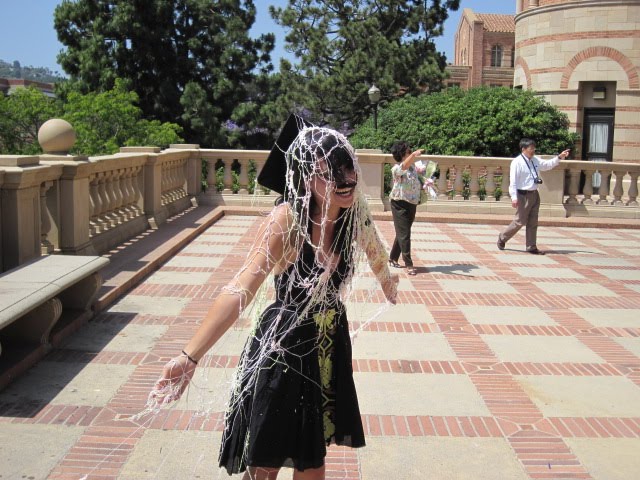
Truth bought silly string to get Peace, but it was confiscated at USC, so it reappeared in the park in San Francisco where everything goes...


On June 12, 2010 at 1:00 pm Truth received a Bachelor of Arts in Linguistics (concentrations: Italian, Chinese, and a certificate in teaching ESL) from UCLA.


She graduated summa cum laude.

But her true ambition is to be a hobo. She will be taking a summer module in Architectural Design before leaving on a trip to Beijing. From there she will go to Mongolia with a friend to ride ponies. Then she will visit relatives in Taiwan and friends in New Zealand. Then she will go on to teach English for a few months to AIDS orphans in Tanzania. On the way home she will visit Morocco and some other African countries and then stop in Hawaii to see a friend. Her mortar board sported a packed suitcase:


Her cheering section was the loudest, so they had to go incognito.


And of course, the previously silly stringed got their revenge with interest...


Congratulations to my babies!!! I'm really proud of you!!

Love always, Mom

Sunday, June 6, 2010

First Snow

Love in a box in the toy room

It seems that my posts have been getting darker as time goes on, but I am trying to record as best I can what we were going through, not because we are anything special, but because we aren’t. I am unique in that I experienced being an immigrant to my own country, and I experienced things that most people of my race, class, and educational background do not experience. Moreover, because my grandmothers, in particular, were worried about my grandfathers’ prestige if we “went on the dole,” our family did this without any social services. Later, in my translation business, I helped newly arrived families with small children “go on the dole;” to be honest, they had a much easier time of it than we did even though they had NO family here. I want to put our experience out there as an example.


America today is in a time period when a certain sector of the populace wants to abolish all social services. Times are tough, and instead of uniting, we seem to be losing that American sense of uniting for the common good that we saw in the aftermath of 9/11 and at other times in our history. As resources get tighter, we are retreating into “tribalism” and trying to shut out all who are different. I feel that this is a huge mistake.

During the Great Depression, the farmers’ march on Washington and the veterans’ encampment on the Capitol Mall put our leaders into fear of riots by the masses. FDR enacted legislation that laid the foundation for our social safety net, and we began several decades of domestic policy designed to increase the percentage of households in the middle class. The wealthy were taxed progressively, and that money was spent to ensure that hunger would not be a problem. Because we are a diverse nation, “tribalism” is particularly dangerous. When the race riots erupted in the 1960’s, Lyndon Johnson launched his Great Society program to bring more minorities into the middle class. Maslow’s hierarchy of needs states it clearly: when people are hungry they do not have the wherewithal to be moral. Other countries that do not have our safety net (tattered as it has become by the past thirty years of political policy favoring the wealthy and increasing income disparity), are already seeing riots by hungry workers who acutely feel their exploitation when they see the wealthy on TV. Thailand comes to mind as an example, as does rural China where farmers and factory workers riot frequently, although the news does not get into the mainstream media. Last year, even chicken farmers in Arkansas, USA rioted because their livelihood was being destroyed by a large polluting corporation. They were put down forcibly by the National Guard.

The Moral Economy of the Peasant by James Scott discusses the mindset of people standing up to their economic necks in water and how they react when a swamping wave comes along. Fanshen by William Hinton describes the brutality of peasant life in China during the early twentieth century that led to revolution upon revolution. That brutality seems to be returning, not only to China, but to the rest of the world. Building a wall won’t keep people out; it’s too late. Globalization has already occurred. And so, part of the reason why I record Yuni’s frustrations and anger as we tried to get a toe-hold, is because he is one of many. Most of our immigrant friends felt the same way and experienced similar discouragements. By dismantling the middle class or by trying to restrict middle-class status to one race or group, we as a society are playing with fire. The lessons from history proving this fact are numerous.

Winter came early our first year in America. One day in mid-November, the skies were grey and it looked like rain. But the temperature dropped. By noon, the ground was covered with a dusting of snow. The snow began to fall thicker and faster, and around two, Yuni called from work to say that the owners were sending everyone home. He thought it might take a little bit longer than usual, but he was confident he would be home for dinner. He was quite excited because he had only seen light dustings of snow on the very tops of Taiwan’s highest peaks. There had not even been enough snow to make a snowman and now he was having snowball fights with his friends in the parking lot. I reminded him not to get wet and chilled.

Since he was coming home before the snow got too deep, I was not too worried. I thought that the freeways would be clear from all the traffic. I bundled the girls into their padded cotton suits with many layers underneath, and we went out into the yard to play. The snow was about three inches deep. The girls had lots of fun making snow angels and running in the cold white stuff. Their Chinese suits were not waterproof, so we could only stay out for about 20 minutes. I got them into a hot bath and then we had some hot cocoa and snacks. They went in to watch Sesame Street and draw pictures while I started dinner.

I thought that Yuni would probably be home by 5 at the latest; that would give him three hours to cover a 40 minute drive. I also thought that he would be cold, so I made a chicken soup and other warming foods—veggies stir-fried in bacon grease and another meat dish in addition to the chicken in the soup. Yuni had not taken his warmest coat with him. He thought it was too much trouble. I was very worried that he would get chilled, but at least he had gloves. He didn’t even have a warm hat, yet.

5:00 came and went. I kept the dishes warming on the stove and in the electric fry-pan. By 6 the girls were hungry, so I fed them. At 7, I ate myself. Now I was really worried. The snow was falling thicker and faster. We stopped watching children’s shows and turned to the news. Some areas already had a foot accumulation. At 8, I called the police to ask if there had been an accident involving a non-English-speaking Chinese man in a huge, brown Town-and-Country station wagon. They took my number and thirty minutes later called back to say that there had been several accidents, but none involving anyone answering that description. At 10, I put the girls to bed and wondered what to do. A little before midnight, I heard stomping on the stairs as Yuni came in. His nose was totally red, but he was sweating. He took a warm bath and got out of his wet clothes. Then he told me his story while he ate. When he was bathing, I went down to look for the car. It was not there. I was very worried, but he insisted on telling it like a folk tale and didn’t let me know what had happened to the car until the very end.

He said:

“I started out on Highway 520 to go across the new floating bridge, but there is a hill as you come out of Redmond into Bellevue. Several cars had spun out there. I braked too quickly, and I spun out, too. I was stuck. I couldn’t get the car to move in reverse. I was right near the on-ramp from Marymoor Park. The man in the car in front of me told me that my car was heavy enough. He helped me push my front around so the car was pointing down the on-ramp. Then I inched my way down, driving the wrong way. I got onto the road that goes by Lake Sammamish and went to get gas first. It was lucky that I did that. Then I remembered that when my parents were here, your dad took us by this lake and along to I-90, so I could get to the other floating bridge and come home. I thought it looked like the same road, but it was hard to see with all the snow. I drove along, and finally I found it. The on-ramp there to I-90 is all downhill. Once I got onto the freeway, the road was pretty clear, but there were so many cars. When I was almost across Lake Washington, and I could see our house on top of the hill, traffic stopped still. I stayed stuck in traffic from 6:00 to 10:30. Finally, traffic began to move. Fortunately, our car is big and heavy; many people with little cars could not get up hills, even with those funny things wrapped on their tires (chains). I took the long way around, so I did not have to go up any steep hills. When I got to that green bridge to come onto Beacon Hill, I saw that a house had burned down. It was still smoldering. The fire trucks had sprayed water all over the road. It was about 11, and the night air had turned the water to ice. My car started sliding down a side street, but I saw the entrance to a parking lot. I didn’t want to leave our only car on the road because cars were getting buried in snow and then hit by other cars. There is an old folks’ home there, you know? So I slid into their parking lot and found a place to park. I didn’t do a good job parking, but at least the car is not on the street. Then I started to walk. The sidewalk was all covered with ice from the water. I had to crawl across the bridge because I could not stand up. It was a little better when I got across until I came to the steep part right before our house. I would walk a few steps and then slide down. Then I’d walk a few more steps and slide back some. But I knew I had to get home. So I crawled when I couldn’t walk, and I made it. Now I’m really tired.”

Yuni’s company was closed again the next day. The whole family trooped down to the car, and then we went down to buy bags of sand and chains. We put the sand in the cargo carrier to weight it, and we put the chains on in the parking lot. Yuni had figured out how to drive in snow the night before. He was already quite good at navigating. We also went to K-Mart to shop for snowsuits for the kids. We couldn’t afford any, but after we got home my dad called to say that he was coming to see us. Lo and behold, he brought three snowsuits for the girls and a warm hat with earflaps for Yuni. I got a nice hat, too.