Monday, January 31, 2022

Chinese New Year Traditions: Guo Nian, Gong Xi or "Congratulations, You Survived the Nian Beast"

On Chinese New Year's Eve, families gather together for New Year's Eve dinner, which is a great feast that I have written about in previous posts. After dinner, they usually watch New Year's specials on TV until a few minutes before midnight. Right around midnight they go outside to pray for good luck in the coming new year, and to make a lot of noise to scare away the Nian Beast. 


The family in the 2021 Lego set is assembled outside right before midnight. They have already set off a few bottle rockets, and they are preparing to light the big string of fire crackers hanging from their door at the stroke of midnight. They also have firepots to keep warm and more bottle rockets ready for the midnight battle with the Nian Beast.

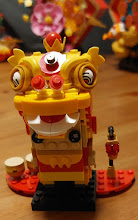
In some places, lion dancers go out in the streets late at night to participate in the noisy midnight celebration. Our Lego lion dancers are all set up for their performance along the main street of the village.


According to legend, at the stroke of midnight, the Nian Beast will come to eat the villagers and destroy their homes. By making noise and burning fires, the villagers hope to scare the Nian Beast and "guo nian" or survive the Nian Beast for another year. 


The Nian Beast arrives at the stroke of midnight. It faces lion dancers, people dressed as animals from the Chinese zodiac, and families with fire pots, bottle rockets, and loud strings of firecrackers popping over their entries. Everyone is screaming and making noise. The lion dancers get into the Nian Beast's face. They are supported by the loud drumming and clashing cymbals from their musicians. 


The noise hurts the Nian Beast's ears, and the fires and lion dancers scare him. He turns around and runs back to his lair in the mountains. 


Everyone congratulates each other for surviving the attack of the Nian Beast. Then, they all go to bed because they want to have fun going out with their families on Chinese New Year's Day. (The lion dancers will have another gig...) "Surviving the Nian Beast" is supposed to be the reason that Chinese people say "gong xi" or "congratulations" to each other on Chinese New Year. 


Saturday, January 29, 2022

Chinese New Year Traditions: Getting Ready

 Chinese New Year is almost upon us. The Year of the Ox will leave, and the Year of the Tiger will begin at midnight February 1. According to tradition, families are supposed to clean their houses well. Red paper strips with lucky sayings written in calligraphy are pasted across the top of the door and on each side doorpost. Red lanterns are hung in the doorway, if the entrance allows it. People buy new, red clothes, and make lots of good food. A favorite is "year cake" or "nian gao," which is made with sticky rice. Of course, Chinese New Year 2022 is happening in the midst of a pandemic surge, and for some people, social distancing makes it harder to keep up with traditions. But, for the Lego people in the Chinese New Year collection series, there is no need to fear infection with a plague. 


In this scene from the 2020 collection, the grandfather is scrubbing the windows and touching up the red paint on the grills. Grandfather's younger brother has just finished pasting the papers with lucky sayings around the front door, and Grandmother has emerged from the kitchen to check on his work. Father has come back from buying more bottle rockets, while Older Brother is dressed as a Chinese zodiac Ox and is hanging a string of firecrackers from the roof. The little kids are making a snowman in the front yard because they are on vacation from school. 


The bottle rockets and firecrackers will all be set off exactly at midnight of the new year. But why make so much noise in the middle of the night? What is up with all the red? And why are there always lion dancers with drums and cymbals and their own bottle rockets at Chinese New Year celebrations? In the 2019 Lego Chinese New Year collection, the village lion dancer club is practicing by the old village gate in the marketplace for their midnight performance in the village streets. 


Legend has it that all the cleaning and decorations on family homes are necessary to protect everyone from being eaten at midnight by the "Year Beast" or "Nian shou." The Nian Beast is said by some to live in the mountains and by others to live in the sea. In all the legends, it comes to places with lots of humans on midnight of Chinese New Year, just as the old year is leaving and the new year is arriving. At this moment, the Nian Beast comes to eat people and animals and to destroy whatever it finds. Some legends say that the lion dancers dress up like the Nian Beast and dance to loud drums and cymbals to scare the Nian Beast away and keep their homes safe. 


This is Lego's version of the Nian Beast. It looks like drawings in folktale books that I have seen. It also resembles the lion dancers' costumes. Will the Nian Beast eat anyone this Chinese New Year? Or will the lion dancers scare it away? 


Sunday, February 9, 2020

Police and Drone Technology in the Time of Corona Virus


The Chinese police are flying a drone into a quarantined area and using the drone to spot people violating the face mask and no gathering rules. They then speak through the drone to call out specific people by the clothes they are wearing and tell them to separate and/or put on their face masks. 

Saturday, February 8, 2020

"I'm Leaving" by Li Wen-liang

The preceding was shared with me by some Buddhist friends in Taipei. The text is attributed to the 34 year old doctor in Wuhan, who spoke out about the Corona virus and who passed away in the last few days. My translation of the text is below:


“I’m Leaving” by Li Wen-liang

Before I become a mote of dust, I quietly remember the black earth and white clouds of my childhood home. I long to return to my childhood, when the wind danced happily, and the snow was pure white.

It is so good to be alive, but I am dying. I will not be able to touch the face of my loved ones, nor will I ever again be able to take my child to watch the sun rise over East Lake in the spring. I will never again be able to go with my parents to see the cherry blossoms at Wuhan University. I will never again be able to fly a kite up into the depths of the clouds.

I often dreamed that my unborn child would come crying into the world seeking me out among the throngs of humanity. I am sorry, my child! I know you want an ordinary father, but I have become a commoner hero.


It is almost dawn, and I will be leaving. I am taking a guarantee as my only baggage from this life. 

I want to thank all those in the world who have understood me, pitied me, and loved me. I know that you will all be waiting for me to climb that mountain at dawn! But I am too tired.

In this life, I never wanted to be as weighty as the sacred Mount Tai, nor was I afraid to be as inconsequential as a feather. My only hope is that after the snows melt, all living things will still deeply love this earth…

When the spring thunder rolls, if there are still those who want to remember me, please place a small tombstone on my grave! It does not need to be anything special; it just needs to prove that I once existed on this earth with a name, ignorant and fearless.

My epitaph only needs to be one sentence:

“He once spoke on behalf of the living.”

Friday, October 11, 2019

The Doctor is In

PhD Dissertation:
  Humanistic Buddhism and Climate Change: Propagating the Bodhisattva Ethic of Compassion for People and the Planet
Dissertation Committee Chair: Richard P. Madsen, Distinguished Professor of Sociology

Outstanding Dissertation Award


PhD in Sociology from University of California San Diego

Sunday, August 2, 2015

Translations of Book and Interview Transcript by Chinese Poet Huang Xiang

Last year I completed my translation of Huang Xiang's book The Thunder of Deep Thought. The advance edition came out in October 2014 in time for the 10th anniversary of City of Aslyum/Pittsburgh where Huang Xiang was artist in residence for two years. This is a link to an interview with Huang Xiang about the book and his other art work that is on the publisher's website  (Huang Xiang video).

The book is now available on Amazon.

Huang Xiang is a poet, calligrapher, and painter. He painted this painting for the cover of the book, and the calligraphy on the cover is a free-form poem.

This is my translation of the calligraphy poem on the painting:
Ice Blue Poetry
by Huang Xiang
            In the days before it was covered with ice and snow and after it was covered with ice and snow and while it is covered with ice and snow or while the ice and snow are melting due to climate change, it has always remained the same planet, hanging and turning in time and space, the same great Earth under the same orb of the sun, where humanity has lived or is living, and from which humanity will disappear in the end.
            In the time and space apart from time and space, who were the earliest visitors to the ice blue world? Who can interpret the mysterious meaning of the ice and snow? Who has discovered the inexplicable, hidden secrets of civilization under the vast layers of ice? I believe that the past, present, and future of different times and spaces are all the same moment of now. The earth and sun both belong to the ultimate meaning of the same ball of ice.
--Translated by Teresa Zimmerman-Liu

Huang Xiang is probably best known in Chinese history for posting one of his poems in big character posters in Beijing and thus sparking the 1987 Democracy Wall Movement. He was recently interviewed about the Democracy Wall and about his work. I translated the transcript of that interview, and he gave me permission to disseminate it. If you are interested in obtaining a copy of my translation of the transcript, email me, and I'll send you a copy. 

You can find information about Huang Xiang's cross-cultural Century Mountain Project by following this link. He has done this project in collaboration with William Rock. 


Sunday, October 13, 2013

Restoration of Health and Family Harmony

After that detour into the history and concepts of Chinese medicine, I want to come back to my narration of our family’s story. As I noted in my first post on Chinese medicine, we moved to California in the mid-1990s. At that time, I could not find a nearby practitioner of Chinese medicine who was able to help me. I went to a friend who is a Western medicine doctor, and he wanted to do exploratory surgery, which our insurance refused to cover without two second opinions, that we would have had to pay for ourselves. We did not have the money, and so upon the recommendation of a friend, I began using homeopathy. My homeopath was quite skilled, and I began to recover my health.

Our relatives in Taiwan had been extremely worried about me, especially when our Western doctor friend mentioned a possible diagnosis of cancer. As I regained my health, the relatives in Taiwan felt it was a total miracle. Pa had developed an eye problem where he could not keep his eyelids open without holding them up with his fingers. He was unable to find a cure through Chinese medicine. He had also gone to one of the big hospitals in Taipei where the doctors gave him Botox injections to keep his eyes open. Then he was unable to completely close his eyes when he wanted to sleep. And so, the Western doctors in Taiwan had prescribed very addictive sleeping pills for him. He was extremely uncomfortable from the side effects of both medications. Since I had had such good results with homeopathy, he and Ma came to visit us so that we could take him to see the homeopath.

My homeopath lived in the Bay Area and only came to southern California on school vacations. Pa and Ma came in the middle of the school year. Yuni was incredibly busy with a large construction project, and so I rallied my southern California friends to help Pa. I have a friend who is a family doctor. She looked at Pa’s medications and said that he should not be on them any longer because the sleeping pills were highly addictive. After Pa was weaned from his sleeping pills, he felt much better, but his eyelids were still a problem. I took him to see another friend, who is an eye doctor, but all she could offer was perhaps better skill at Botox treatments. Pa was not interested in those. That night, when Yuni got home for dinner, Ma and Pa broke out their best guilt-tripping skills to get Yuni to take us up to the Bay Area so that Pa could see the homeopath. Yuni finally gave in and asked me to set up an appointment. The homeopath was very busy, but we were able to get an extra-long introductory appointment for two weeks after that date. I would do the interpreting for homeopath, and then we would take Pa and Ma sightseeing in San Francisco while we were there. Yuni was relieved to have two weeks in which to arrange for the time off from work.

Homeopathy is a holistic system of medicine that uses very mild natural remedies. The initial appointment consists of a long interview in which the homeopath seeks the physical and psychological roots of the problem, which are found in the patient’s constitutional indications. Over the course of the interview, I learned that Pa had had surgery as a young man in which almost two thirds of his stomach was removed. We also learned that he had been unable to eat well due to his emotional upset over the situation with Elder Sister, the problem between Yuni and my father, and my own illness. Instead of treating his eyes, the homeopath treated his stomach and prescribed a remedy that would calm his nerves and help him better absorb the nutrients from his food. Within a few weeks, his eyes were much improved. The trip to the Bay Area restored harmony to Yuni’s relationship with his parents. They went home happy with an admonition from the homeopath to return in six months for a follow up appointment.

Six months later, Pa, Ma, and Yuntian all came to the US to get treated by the homeopath. Pa was feeling better than he had felt in years. Ma and Yuntian wanted help with their chronic health issues, too. We made appointments spaced over the course of two days for all of them. The homeopath was able to prescribe helpful remedies for Ma and Yuntian, and she made some slight adjustments on Pa’s dosages. Ma and Yuntian also responded well to their remedies. Pa and Ma did not stay too long after their health appointments. We all took a few day trips with Yuntian to Disneyland, Sea World, and Tijuana, Mexico. Pa was much happier on these visits to Disneyland and Sea World than he had been on his previous visits to them.

Yuntian had been authorized upon entry to stay in the US for four full months, and he decided to make the most of his visa permission. Pa then mentioned to Yuni that Elder Sister’s family desperately needed money. He had sold our house in Chungli and had paid off our debts to the other sisters, but he was only able to repay part of what we owed Elder Sister from our share of the proceeds of the Chungli house. Pa had taken his share of the money and bought a cheaper house out by Yuni’s old military camp where there was more room. The neighborhood around our old house had been completely built up, and Pa needed elbow room. Our tenants in Washington told us that they would only be renting for another six months, and so we decided to put that house on the market. The house needed reroofing before we could sell it. Yuntian decided that he would stay with us to help reroof our house, and in the process he would get a sightseeing trip up the coast and then down the mountain range between southern California and Washington State.

It had been three years since I had had contact with my father, and I decided that this was the time to insist on a visit with him while we were in the Seattle area. I knew what I needed to do as a Chinese wife, even though I really do not like using guilt trips and histrionics to get my way. I much prefer straight forward discussions and good-faith negotiations. But I also knew that since I had helped his parents and had just recovered from a severe illness, I was at a prime time for pushing my point, especially since Yuntian was there to back me up. There is a certain ritual to these intra-family dealings in the Liu family's culture.

I did not bring up anything about reconciling with my dad until we had been out on the road for a couple of days. Then I made a scene and played the guilt-trip card, begging Yuntian to plead my case with his brother. Yuntian and the kids all begged Yuni to let me see my dad. Because I had been so sick and had still found a way to improve the health of his parents and brother, Chinese family customs demanded that Yuni give me some kind of reward. He did it in a way that saved him some face by saying that we could all go to dinner with my dad (Yuni would pay), and if I wanted to spend time alone with my dad and his new wife, that was fine. However, he kept the restriction that the girls could not spend time alone with their grandfather until they were older. When we got to Seattle, I called my dad and made arrangements to spend time with him. I think that eventually, we all went with Dad and his wife to the Seattle Center on my dad’s dime, and then Yuni took us all to dinner.

And so finally, at about the same time that Elder Sister was making headway in her quest to be reaccepted by Elder Brother-in-law’s family, my husband and father were able to begin to resolve their differences, and my life moved onto a more even keel. At least, I no longer felt caught in the middle of a cross-cultural struggle.


While we were on the trip to Washington, Yuntian received a phone call from his girl friend. She was pregnant with his child. Part of the reason Yuntian had wanted to stay behind in the US was that he wanted to wait until he knew if his girl friend was pregnant. Ma did not approve of the girl because she was not a Christian, but according to Yuntian, Ma kept parading fat, pimple-faced Christian women in front of him in her matchmaking efforts. He refused to consider women in whom he had no interest just because Ma liked them. Now he HAD to marry his girl friend because she was carrying his first child. When we got back to California, Yuntian rushed to book his flight home and prepare for his wedding.